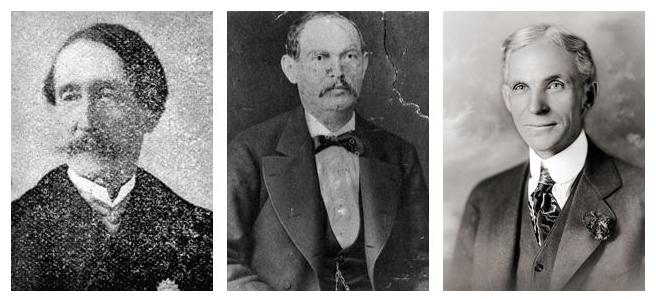
The three Henrys: Bergh, Bliss, and Ford. (Credit: Wikimedia Commons)
On September 13, 1899, a dour-looking Manhattan real estate salesman named Henry Bliss stepped off a streetcar near Central Park. As he turned back to the trolley to help his female companion disembark, an electric taxicab struck him. The carriage-like vehicle knocked Bliss to the pavement and ran over his head and body, crushing both. When he died the next morning, he became America’s first pedestrian killed by an automobile.
Bliss’s death signaled a new era for New York. The city’s streets had once been fluid with horses. Hundreds of thousands of the animals towed railroad cars and fire wagons, barges and slaughter carts. The metropolis ran on its horses—and it worked them to death. The animals were so plentiful that it was cheaper to buy new ones than to properly care for them. And so drivers starved them, whipped them bloody, and left them to die on the side of the road when they collapsed. Too heavy to move, their bodies were allowed to rot until they had decomposed enough for wagons (drawn by horses) to pick them up and dump them in the river—or ship them to factories that turned them into glue, grease, and fertilizer. Horses can live for more than 30 years; in mid-nineteenth-century New York, they were lucky to reach their second birthday.