

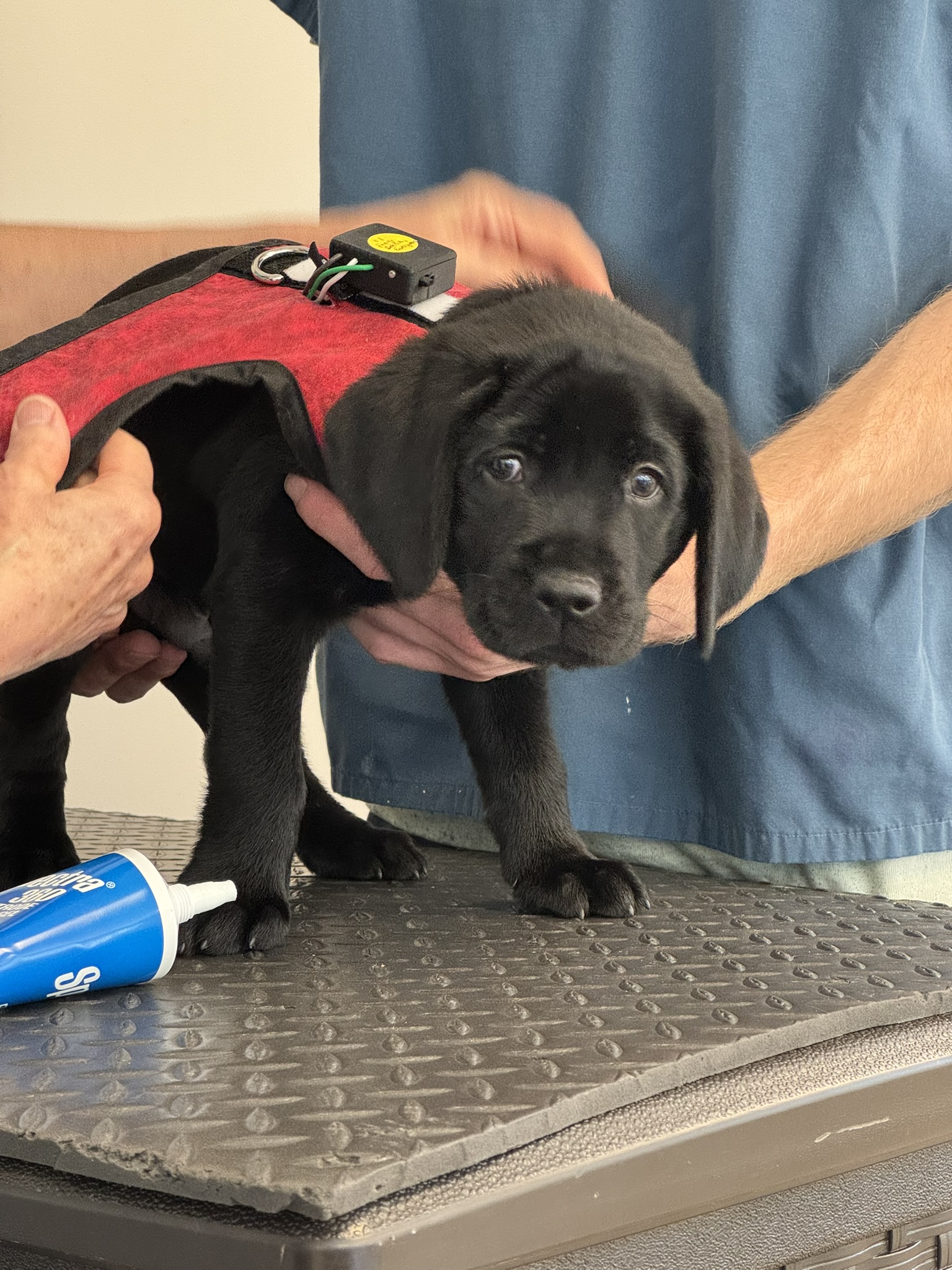
Ivan the puppy gets fitted with an electronic vest as part of his evaluation at Guiding Eyes for the Blind. (Credit: David Grimm)
About four years ago, I was scanning the scientific literature when a study title caught my eye: Advancing Genetic Selection and Behavioral Genomics of Working Dogs Through Collaborative Science. That might seem like a mouthful, but it was the “working dogs” part that intrigued me. I’ve thought often about working dogs–animals that guide the blind, soothe kids with autism, and sniff out bombs. I had even written about military working dogs in my book, Citizen Canine. But I never thought about the science behind them.
So I dug further into the study, and what I read surprised me. Despite decades of breeding and hundreds of working dog schools around the world, more than half of all working dogs fail to graduate. Some are felled for behavioral reasons like a lack of impulse control, others for health reasons like hip and elbow dysplasia. And that means that these organizations can spend years and tens of thousands of dollars to train a dog, only to have it end up as a family pet (not that there’s anything wrong with that!).
Science could help. The article I read spoke about “estimated breeding values”–statistical calculations that have long been used by the livestock industry to improve milk and meat production. Such values, when applied to dogs, could help working dog organizations improve the health and trainability of their canines–indeed, schools have already notched some successes with them. Other groups are taking a different tack: employing “cognitive test batteries”–a series of rigorous mental tasks that could help working dog organizations figure out which dogs are most likely to graduate, and which jobs they’ll be best suited for.
As I reported this story, I got to visit Canine Companions in Santa Rosa, CA, one of the world’s largest working dog schools, and Guiding Eyes for the Blind in Patterson, New York, one of the biggest guide dog schools in the U.S. I saw puppies in training, adult dogs that performed some remarkable tasks, and scientists applying cutting edge research into the raising and training of these animals. A lot of this work is still in its early stages, but it has the potential to revolutionize the working dog pipeline, and to help more of these talented canines get into the hands of the people who need them most.
You can read my story here (pdf), listen to me talk about it here, and read my account of being a guide dog guinea pig here.